Blog

  • Personal Growth Books: How to Pick the Right One When You Feel Stuck

    Personal growth books are easy to find and hard to choose between, especially when you feel stuck and can’t say why. A shelf of hundreds of titles all promise a better life. The way to choose is to name what you’re stuck on, match it to a type of book, and read one title before buying a second.

    What personal growth books are actually about

    Personal growth books, often shelved as self-help, teach a method for changing something about how you think, act or live. Some focus on habits and daily routines. Others deal with mindset, purpose, relationships, money or stress.

    The common thread is a practical question: what can a reader do differently? A good one answers it with specific actions or exercises. A weak one repeats encouragement without ever telling you what to do on Monday morning.

    Are personal growth books worth reading?

    Yes, when you pick the right one and use it. A book can give you a clearer way to describe your problem, a method to try, and a reason to start. That is useful, and it costs less than most courses or coaching.

    They are a poor use of money when you read them as entertainment. If you finish a book feeling motivated and change nothing, the book cost you an evening and gave you nothing back.

    Can a personal growth book change your life?

    A book can show you something and suggest what to try. It can’t do the trying. Your life changes when you apply an idea repeatedly, usually in small ways and over weeks or months.

    What a book can do:

    • Name a problem you hadn’t been able to describe
    • Offer a method that has worked for other readers
    • Give you exercises and prompts to work through

    What only you can do:

    • Choose one idea and act on it
    • Keep going when the novelty wears off
    • Adjust the advice to your own circumstances

    How to pick a personal growth book: start with what you’re stuck on

    “Stuck” covers several different problems, and each one calls for a different kind of book. Finish this sentence in one line: “I’m stuck because I…” Your answer points to a category.

    • I know what to do and don’t do it: habits and systems books
    • I keep talking myself out of things: mindset and thinking books
    • I don’t know what I want: purpose and direction books
    • My relationships or work conversations go badly: communication books
    • I’m overwhelmed or burned out: stress, rest and boundaries books
    • My money or career feels unsteady: work and money books

    Which personal growth book should you read first? A simple way to decide

    Choose the category that matches the problem costing you the most right now, not the one that interests you most. Then check three things before you buy:

    1. Read the table of contents. Chapters that name specific skills or actions are a good sign.
    2. Read a sample chapter. If the writing makes you want to keep going, that matters more than the reviews.
    3. Check the length. A shorter book you finish beats a long one you abandon.

    Pick one book and set the others aside. Reading three at once is a common way to end up applying none of them.

    Books like Atomic Habits and the 7 Habits: how to find similar books by type

    Readers often start from a book they’ve heard of and ask for something similar. Looking at the type is more reliable than looking at the cover. Atomic Habits is a habits and systems book: it breaks behavior change into small repeatable actions. The 7 Habits of Highly Effective People is a principles and character book: it focuses on how you set priorities and deal with other people.

    If you liked the first, search for other books on habit formation and routines. If you liked the second, look for books on effectiveness, priorities and personal responsibility. Then apply the same checks: table of contents, sample chapter, length. Similar topics don’t guarantee a similar reading experience, so the sample matters.

    Free PDF downloads and other ways to read without overspending

    Searching “personal growth books PDF free download” turns up plenty of results, but many are unauthorized copies of books still under copyright. They often come with poor formatting, missing pages or unsafe download sites, and the author earns nothing from them.

    Better ways to read cheaply:

    • Borrow from your public library, including ebook and audiobook lending
    • Buy used copies, since most of these books stay in print for years
    • Read the free sample on an ebook store before you buy
    • Look for older titles whose copyright has expired and are legally free

    How to start personal growth reading and finish what you pick up

    Start with one book and a small, regular reading slot, even ten pages a day. Keep a notebook beside you and write down one action from each chapter. Do that action before you read the next chapter.

    Most readers stall midway through, and there are specific fixes for it. This guide on how to finish a self-help book covers them in full.

    Join my email list for plain, practical book recommendations from c.w. Pickett, sent to readers who want to know which self-help book is worth their time next.


  • Why You Never Finish Self-Help Books, and a Simple Way to Get to the Last Page

    Why You Never Finish Self-Help Books, and a Simple Way to Get to the Last Page

    Most people who buy self-help books never reach the last page. A bookmark sits somewhere around chapter four, and the book goes back on the shelf. The usual advice is to read more, read faster, or set aside twenty minutes a day. That advice treats the problem as a scheduling issue.

    A well-worn paperback on a wooden bookshelf with a bookmark sticking out a third of the way in, dust on the neighbouring spines, soft afternoon window light and muted warm browns.

    The problem is usually how the book is read. A novel asks you to follow along, so you can read it passively and still finish. A self-help book asks you to change something. Read passively, it gives you ideas and nothing to do with them, and when nothing happens there is little reason to keep going.

    If you want to know how to finish a self-help book, the answer is to finish it by applying it. The method has four parts: choose one question before you start, read with a pen, write one action after each chapter, and do that action before you move on. The sections below cover each part.

    Decide what you want from the book before you open it

    Before chapter one, write down one question you want the book to help you answer. Make it specific enough that you would recognize an answer when you saw one.

    “How do I improve my life?” is too broad. These work better:

    • How do I start a project I keep putting off?
    • How do I stop avoiding one difficult conversation?
    • How do I make a decision about changing careers when I can’t tell what I want?

    Write the question on the inside cover or the first blank page. It gives you a filter for everything that follows. A passage that helps answer it gets your attention, and a passage that doesn’t can be skimmed.

    An open book on a desk with a single handwritten question in blue ink across the inside cover page, a pen resting beside it, warm lamp light and cream paper.

    The question also lets you check the book quickly. Read the table of contents and the introduction with your question in mind. If neither suggests the book addresses it, you may have the wrong book, and it is better to find that out in five minutes than in five weeks.

    Why you stall at chapter four (and why it isn’t laziness)

    Many self-help books follow a similar shape. The opening chapters describe the problem, explain why it matters, and often tell the author’s story. These chapters are easy to read because they mostly describe what you already feel, and being understood is pleasant.

    Around chapter three or four, the book usually starts asking for things. There are exercises, habits to build, questions to answer in writing. This is where reading stops being easy, because you can’t absorb a task the way you absorb a story. If you keep reading without doing the exercises, the book still piles up instructions, and each one adds to a mental to-do list you haven’t started.

    Two other things make the stall worse:

    • Gaps between sessions. If you skip a week, you have to remember where you were and what the book was arguing. The book starts to feel like a chore you are behind on.
    • No sign of progress. Nothing in your life has changed, so nothing tells you the book is worth the time. Continuing feels optional, and optional things get dropped.

    Stalling here is a predictable result of reading an action book in a passive way. Fixing it takes a change of method more than a change of character.

    Read with a pen: what to mark and what to ignore

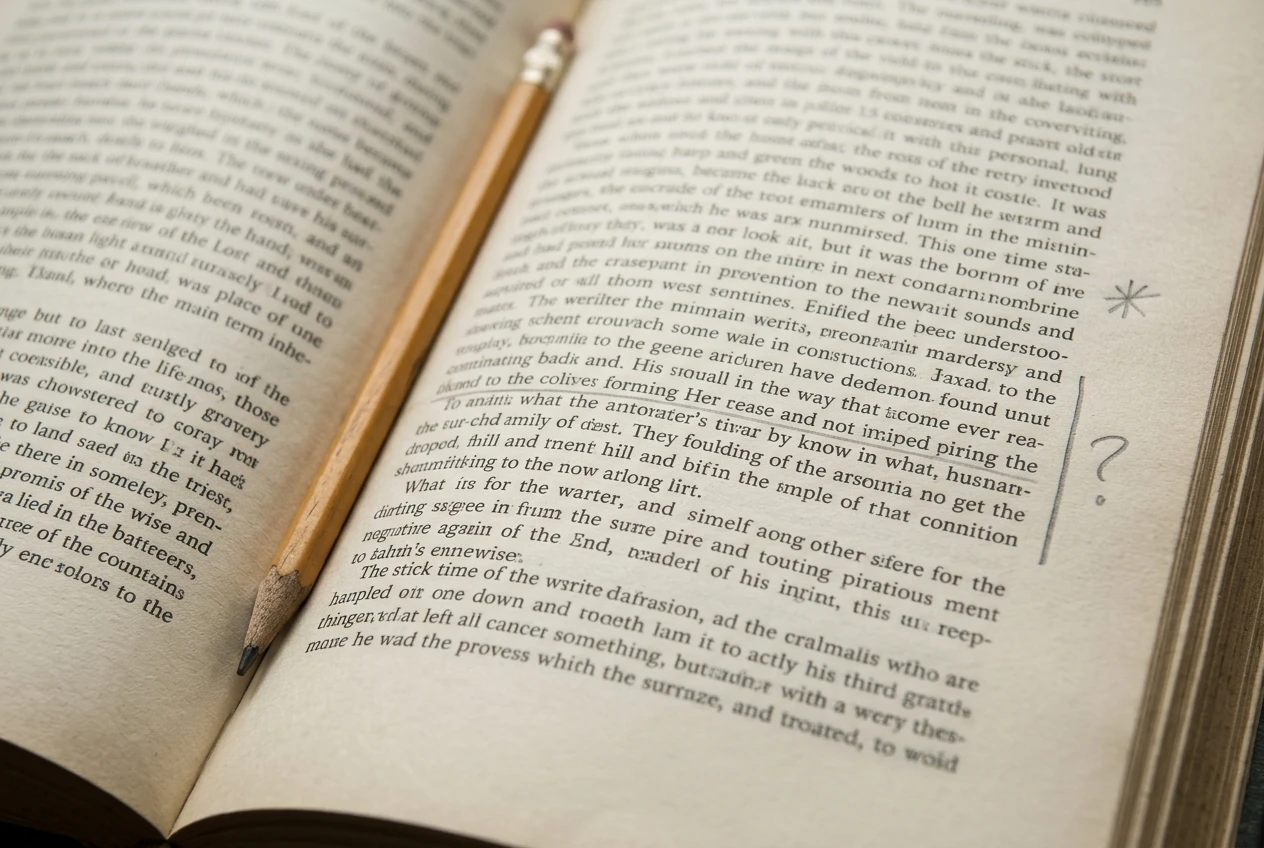
    Reading with a pen means you are making decisions about the text as you go. Use a pen or pencil in a book you own, sticky notes in a library book, or the highlight function and a notebook for an e-book.

    Mark these:

    Close-up of a book page marked up in the margins with a small star, a question mark and a vertical line beside one paragraph, a pencil lying across the gutter, soft side light.
    • Sentences that directly answer the question you wrote at the start.
    • Any instruction aimed at you, meaning anything that tells you to do, stop, try, or ask something.
    • Claims you disagree with. Write a few words in the margin saying why.
    • Examples that closely match your own situation.

    Ignore these:

    • Anecdotes and stories, unless one clearly carries a lesson you can use.
    • Summaries that repeat what the last page said.
    • Interesting ideas that have nothing to do with your question.

    That last group is the hardest to skip, and it is where most readers lose their focus. An interesting idea that doesn’t serve your question can wait for another book.

    A simple system keeps the marks useful. Draw a star next to anything you could act on, a question mark next to anything you want to check, and a line beside a key idea. If you are marking more than a few passages per page, you are highlighting, not choosing. Go back to your question and mark only what serves it.

    The one-action rule: stop after each chapter and write down one thing to do

    When you finish a chapter, close the book and write one action in one sentence. Do this before you read the next chapter.

    A good action has three features:

    A closed book beside an open notebook where one short sentence is written on an otherwise empty page, a pen on top, a mug of tea at the edge, morning light on a kitchen table.
    1. It starts with a verb.
    2. It is specific enough that someone watching could tell whether you did it.
    3. It is small enough to start within a week.

    Compare these two:

    • Vague: “Be more confident at work.”
    • Usable: “Speak up once in Thursday’s team meeting with a question about the budget.”

    The vague version gives you nothing to do on Thursday. The usable version does.

    Some chapters won’t produce an action. When that happens, write one sentence about what the chapter changed in how you see your problem, or write “no action” and continue. If this happens chapter after chapter, that tells you something about the book, which the section on abandoning books below covers.

    The rule slows you down, and that is its purpose. Choosing one action forces you to decide what mattered most in the chapter, which is the work a passive reader never does.

    Do the action this week, not someday

    An action written down and never done is a longer to-do list. The next step is to attach it to a day and a time. Put it in your calendar or on a note you will see, with something like “Tuesday after dinner” rather than “soon.”

    How you handle it depends on its size:

    • Under a day of effort. Do it before you start the next chapter. Making a phone call or clearing one drawer takes little time, and the book then has an effect on your life.
    • Needs repeated practice. Start it before you move on, then keep it going while you read the next chapters. A daily ten-minute habit, for example, can begin on day one and continue alongside the rest of the book.

    This will make the book take longer to read. A book finished over ten weeks with ten small changes made is worth more than one finished in a weekend with none. And the actions give you a reason to come back to the book, since the next chapter builds on something you have already tried.

    If you try an action and it doesn’t work, write a line about why. That is useful information, and it counts as doing the action.

    What to do when a book is not worth finishing

    Finishing is useful only because it usually means you applied the ideas. If a book is not helping, finishing it wastes the time you would spend on a better one.

    These are signs the book is not right for you:

    • You can’t write a usable action for several chapters in a row.
    • After the first three chapters, your question is still unanswered.
    • The advice is vague, such as “believe in yourself,” with no way to act on it.
    • The same idea is repeated in new words from chapter to chapter.
    • The advice conflicts with what you know about your own situation, and you can explain why.

    Give each book a fair test. Read the first three chapters with your question in mind and do the actions. If you have nothing to show for it, stop on purpose. Write one line on the inside cover saying why, then pick another book or look for one that fits your question better.

    Stopping on purpose is different from drifting away. When you drift, you tend to feel guilty and avoid the shelf. When you stop deliberately, you have a reason written down, and you can pick the next book with better judgment.

    Keep a one-page record so the book doesn’t evaporate

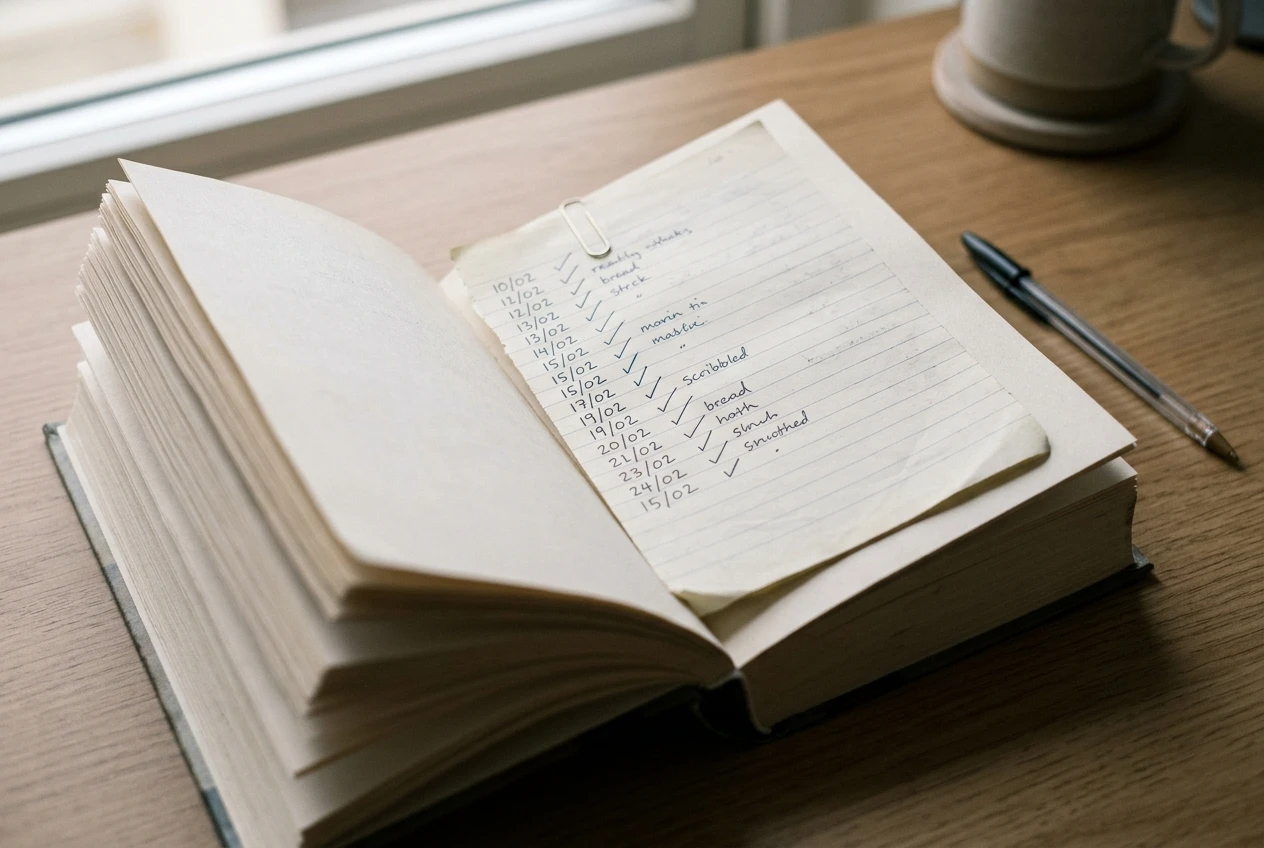
    A year after you finish a book, you will remember very little of it unless you kept some notes. A single page is enough. Use a notebook page or a printed sheet, and include:

    A single sheet of handwritten notes with a dated list of ticks, clipped inside the back cover of a finished book on a tidy desk, neutral tones and gentle daylight.
    • The book’s title and author.
    • Your starting question.
    • A list of chapter actions, each with the date you did it.
    • A one-sentence answer to your question at the end, even if the answer is “this book didn’t solve it, but it showed me X.”
    • One passage or idea you want to reread.

    Keep the page somewhere you will find it. When you need the book again, the page tells you what you tried, what worked, and what to revisit. It also makes the next book easier to choose, because your list of past questions shows what you keep returning to.

    Get the chapter action sheet for your next book

    The email list sends plain, practical book recommendations, along with the one-page chapter action sheet described above, so you can apply the method to whatever book you pick up next. Join the email list to get both. If you want to know who writes the recommendations and what the site covers, the About page explains it.

  • Welcome to Your New Website

    Welcome to Cwpickett! This is your first post. Edit or delete it, then start writing!

  • Hello world!

    Welcome to WordPress. This is your first post. Edit or delete it, then start writing!